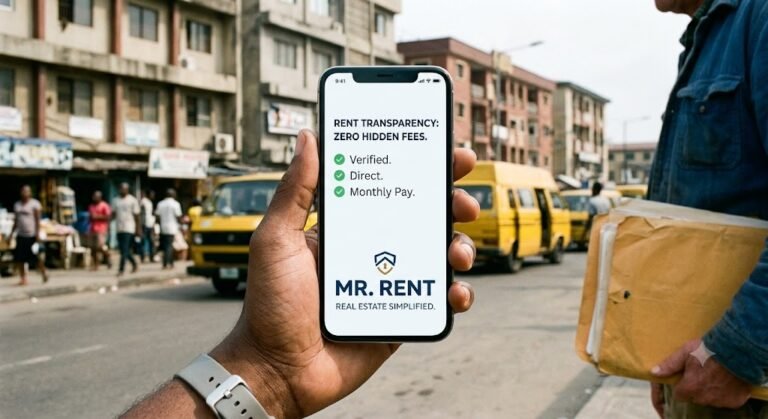




Land/property fraud isn’t a rare, unlucky event in Nigeria — it’s close to the default risk of every transaction. If you’ve ever bought land, rented an apartment, or even just discussed property with a Nigerian family, you’ve probably heard a version of the same story: a deposit paid to a “landlord” who didn’t own the land, a Certificate of Occupancy that turned out to be forged, or a plot sold to three different buyers in the same month.
This is the problem Mr. Rent was built to solve, and it’s personal for me. Before I became a full-time technology founder, I worked as a property agent, and in 2023 I was directly involved in stopping a real estate fraud transaction in Ebonyi State before it could claim another victim. That experience is part of why Veryland — Mr. Rent’s document verification layer — is not a bolt-on feature. It’s the core of the product.
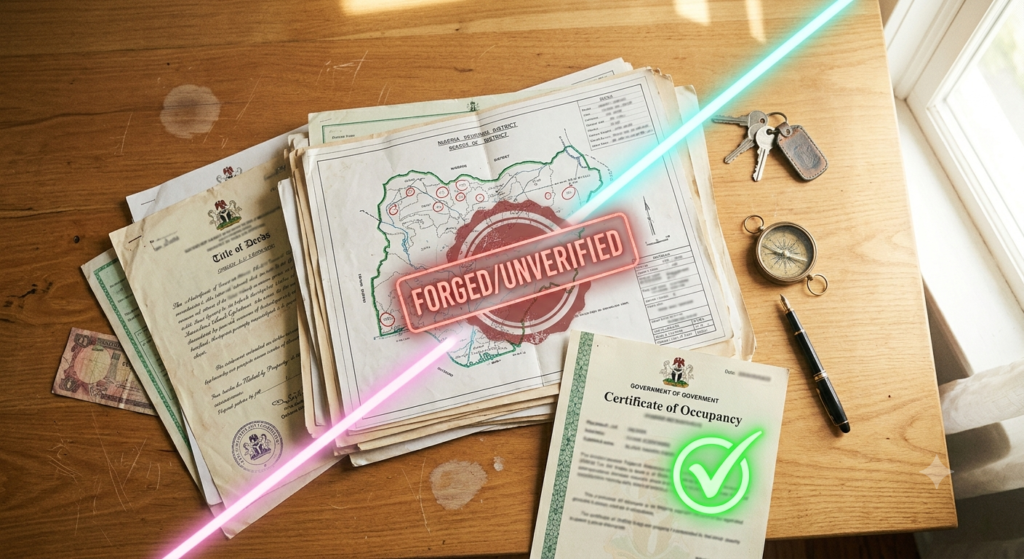
The scale of the problem
The numbers make it clear this isn’t a fringe issue:
- The Nigerian Institution of Estate Surveyors and Valuers has stated that real estate scams account for roughly a fifth of all property-related disputes nationwide, and in Lagos, analysis citing NIESV data found that 42% of property disputes in 2023 involved fraudulent transactions.
- The EFCC has publicly reported hundreds of real estate fraud cases with losses running into the billions of naira, and its Land and Property Fraud Section has openly called for closer collaboration with state housing regulators like LASRERA to close the gaps that fraudsters exploit.
- Industry reporting on Lagos and Ogun corridors has found that a very large share of land titles carry some risk of contestation, a sign that fraud has become structural rather than exceptional in fast-growing markets.
These aren’t abstract figures. Every one of them represents a family that lost savings, a diaspora Nigerian who paid for land they’ll never see, or a small business whose office lease turned out to be built on a disputed plot.

Why Property fraud persists: it’s a documentation problem, not just a trust problem
Nigeria’s land system was built for a paper world. The Land Use Act of 1978 vests all land in a state in the Governor, and any transfer of a right of occupancy legally requires the Governor’s Consent before it’s valid. That single requirement — sound in principle — created a slow, manual, state-by-state bottleneck that fraudsters have learned to route around by forging documents, double-selling the same plot, or targeting buyers who don’t know which registry to check.
Add to that the fact that land records across most Nigerian states still aren’t fully digitized, and you get an environment where a convincing photocopy and a fake agent ID are often enough to defraud a buyer, especially one transacting remotely or under time pressure. This is exactly the pattern documented across Guzape 2 in Abuja, Lekki-Ajah-Ibeju in Lagos, and countless smaller, unreported cases in Awka and Onitsha, where I’m building.
How Mr. Rent is designed to close the gap
Mr. Rent doesn’t try to rewrite Nigerian land law — no single startup can. What it does is remove the specific points of failure that fraudsters rely on:
1. Veryland verification badge. Before a listing carries the Veryland badge, the property and its documentation go through a structured check. Listings without it are visibly unverified, so buyers and tenants are never guessing about a property’s status the way they are on WhatsApp groups or informal listing sites.
2. Contact-reveal instead of open contact info. Property fraud often starts the moment a fake “agent” gets a buyer’s phone number and moves the conversation off-platform. Mr. Rent’s contact-reveal fee model keeps the initial interaction on-platform and tied to an identifiable landlord account, which creates a paper trail that doesn’t exist in a random Facebook Marketplace exchange.
3. Landlord subscriptions instead of anonymous postings. Anyone can post a fake ad for free. Requiring a landlord subscription raises the cost of running a scam operation at scale and gives Mr. Rent an ongoing relationship with the account posting the listing, rather than a one-off anonymous ad.
4. A single source of truth for a listing’s history. Because Mr. Rent is built as a proper platform — not a classifieds board — the same plot or apartment can’t quietly reappear under five different fake identities the way it can across scattered social media posts and print flyers.
None of this replaces a buyer’s own legal due diligence — a search at the state land registry and an independent lawyer’s review remain essential, and Mr. Rent actively encourages both. What it does is remove the easiest, cheapest property fraud vectors: fake listings, unverifiable agents, and untraceable contact.

Part of a bigger picture
Mr. Rent is one product inside a wider push I’m building at Faster Aim Technology to bring more trust and more competence into how Nigerians transact and work online. On the education side, fasteraim.com trains people on practical, in-demand tech and AI skills, and the Business Automation Services I built there exist for the same underlying reason Mr. Rent exists — replacing manual, error-prone, trust-dependent processes with systems that verify themselves. If you want to go deeper on how Mr. Rent’s verification and dashboard workflow actually works day-to-day, that’s covered on the platform itself at rent.fasteraim.com.
The honest limits
I want to be direct about what Mr. Rent can and can’t do. It can’t change the Land Use Act, digitize every state registry, or stop property fraud that happens entirely off-platform, in cash, between two people who never touch the app. What it can do is make the platform itself a place where verification is the default, not an afterthought — and make it progressively harder for the kind of ghost-estate and double-allocation schemes documented across Abuja and Lagos to survive on Mr. Rent the way they do elsewhere.
Ending land/property fraud in Nigeria will take regulatory reform, faster digitization of state land registries, and stronger EFCC-LASRERA style coordination between states and federal agencies — efforts already underway that Mr. Rent is built to complement, not replace. My bet is that the platforms that win in this space will be the ones that treat verification as the product, not a feature bullet point. That’s the bet Mr. Rent is built on.
Daniel Chinaemere Igboke is the founder of Faster Aim Technology Limited and builder of Mr. Rent. Explore verified listings at rent.fasteraim.com or learn practical tech and AI skills at fasteraim.com.