



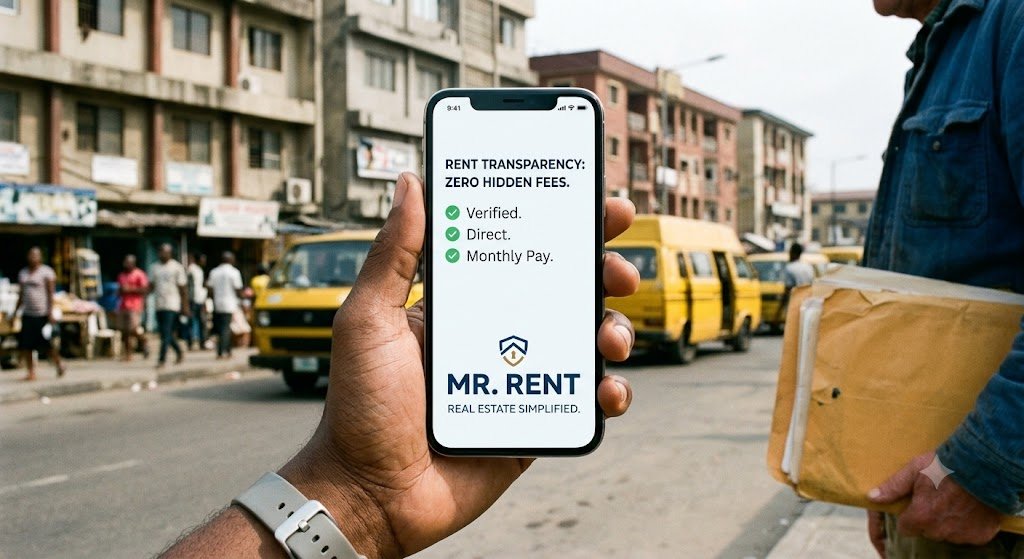
Rental Agency Fees in Nigeria: 5 ways, How Mr. Rent Technology Can Dismantle the “Middleman Tax”
It’s no secret: finding a home in major Nigerian cities — from Lagos to Abuja to Port Harcourt — has become an endurance sport. Beyond soaring base rents, everyday renters face an even tougher hurdle: rental agency fees in Nigeria that arrive after you’ve already fallen in love with the apartment, often stacked on top of legal and caution charges nobody warned you about.
The law is supposed to protect tenants from runaway rental agency fees in Nigeria. The Lagos State Real Estate Regulatory Authority (LASRERA) and the Lagos State Tenancy Law cap agency fees at a maximum of 10% of annual rent, and explicitly outlaw “caution fees,” inspection fees, and finder’s fees as arbitrary add-ons. In practice, enforcement is weak, and many tenants still pay well above that limit.
One tenant’s story, reported by Nairametrics in late 2025, put it starkly: on an annual rent of ₦400,000, he paid an additional ₦300,000 in agency and legal fees — 75% of the base rent — effectively doubling his move-in cost for a one-bedroom apartment. WhatsApp listings surfacing in Lagos rental groups tell the same story at a larger scale: a ₦2.5m apartment routinely arrives with a “total package” north of ₦3.7m once agency fees, commission, caution fees, and service charges are stacked on top.
There’s even a proposed Lagos State Tenancy and Recovery of Premises Bill that would cap combined agency and legal fees at 5% of annual rent — though as of this writing it remains in committee and isn’t yet law.
High rental agency fees in Nigeria aren’t really a pricing problem. They’re a distribution problem. To make housing accessible, we don’t just need more buildings — we need to fix the broken channel between the person who owns a property and the person who wants to live in it. Here’s how a modern rental platform like Mr. Rent is built to close that gap.
The Strategic Blueprint: How We Lower Rental Agency Fees in Nigeria
Lowering rental agency fees in Nigeria isn’t about forcing landlords to accept less income; it’s about removing friction, risk premiums, and unaccountable intermediaries from a transaction that, at its core, should just be two parties agreeing on a price.
- Direct landlord-tenant connections. By listing properties directly and letting tenants message landlords through the platform, we cut out the layers of sub-agents who each take a cut before a prospective tenant ever sees a genuine listing. This is the same principle behind Mr. Rent’s contact-reveal model — tenants pay one clear, upfront fee to unlock verified landlord contact details, instead of an open-ended commission negotiated in person.
- Standardized, digitized agreements. Legal fees in Nigeria’s rental market typically run 5–10% of annual rent for what is, in most cases, a reused lease template with minor edits. Replacing that with automated, digitally generated agreements collapses a five-figure naira charge into a near-zero marginal cost, without cutting corners on enforceability.
- Verified land and title auditing. A meaningful share of rental risk — and the reason landlords and agents justify high fees — traces back to disputed titles, forged documents, or properties that were never legally the landlord’s to let in the first place. This is exactly what Mr. Rent’s Veryland verification badge is built to solve: cross-checking a property’s Certificate of Occupancy, Survey Plan, and Deed of Assignment before a listing carries a “verified” mark. Fewer disputes downstream means less risk premium baked into every transaction upfront.
- Flexible payment structuring. Nigeria’s rental market runs almost entirely on demanding a full year (sometimes more) of rent upfront — a practice that’s technically restricted under Lagos’s own tenancy law for lower-value properties, yet remains the norm because landlords have no easier way to get paid reliably. Platforms that can guarantee landlords their income while giving tenants a path toward monthly or quarterly payment plans relieve that liquidity crunch without shortchanging property owners. Lagos State’s own housing office has said monthly rent payment is a stated long-term policy goal — technology can get there faster than regulation alone.

What We Must Do MORE Of to Cut Rental Agency Fees in Nigeria
- MORE direct, verified listings. Onboard property owners and legitimate managers directly through Mr. Rent’s landlord dashboard, bypassing the informal, unregulated “street agent” layer that current reporting shows is where most of the illegal fee-stacking happens.
- MORE transparent, published pricing. Show tenants exactly what a listing costs before they view it — no “total package” surprise once negotiations start. Agency fee ranges published by industry sources swing anywhere from 5% to 20% depending purely on “the whims of your agent” — that variance is exactly what published pricing removes.
- MORE automated verification and legal tooling. Replace manual, negotiated legal and title-check fees with instant, low-cost digital execution — this is the job Veryland’s document verification flow and Mr. Rent’s automated agreements are built to do.
- MORE flexible cash-flow options. Work toward rent-now-pay-monthly structures that get landlords paid on schedule while letting tenants align rent with their salary cycle instead of draining a year of savings in one transaction.
What We Must Do LESS Of
- LESS reliance on unaccredited intermediaries. Every unverified sub-agent in a transaction is another point where fees get added with no accountability — industry breakdowns show how many separate parties can each claim a cut of a single transaction before it’s done.
- LESS upfront lump-sum pressure. The 12-to-24-month upfront rent norm — already flagged as excessive under existing tenancy law in places like Lagos — locks up capital that could otherwise go toward furnishing a home, starting a business, or simply staying financially stable.
- LESS hidden charging. Caution fees, inspection fees, and vague “service charges” should be itemized and disclosed before a tenant commits, not discovered at the point of payment.
- LESS undocumented risk. Every listing without a verifiable title check is a landlord, tenant, or both, exposed to a dispute that could have been caught upfront. This is precisely the gap PropertyPro’s own guidance to tenants keeps circling back to without a platform-level fix.
The Path Forward
Nigeria’s housing affordability crisis won’t be solved by technology alone — but runaway rental agency fees in Nigeria, the specific friction that turns a ₦400,000 apartment into an ₦700,000 move-in cost, are a solvable problem, and it’s the one we’re building Mr. Rent to solve first.
If you’re a tenant tired of paying for opacity, browse verified listings on Mr. Rent and see the total cost upfront, before you negotiate anything. If you’re a landlord tired of unreliable agents and vacant units, list your property directly and let verification do the work that used to take a lawyer and a stack of paperwork. Read more on how Faster Aim is building AI-driven tools for Nigerian small businesses and renters across our platforms.
The goal isn’t to make renting free. It’s to make renting honest.
Rất đáng đọc, cảm ơn tác giả. Công ty Letco cung cấp dịch vụ du học Hàn Quốc trọn gói, tư vấn tận tâm và minh bạch chi phí. Tìm hiểu tại letco.vn.
Very much worth reading, thank you to the author. Letco Company provides all-inclusive study abroad services for South Korea, with dedicated advice and transparent costs. Learn more at letco.vn”
Thanks for the review